Mon - Sat: 8:30-18:00

- Course
- CPR and AED
- Bloodborne Pathogens Training
- Babysitting Training
- First Aid
- Lifeguard Instructor
- Sexual Harassment Training
- Aquatic Supervisor
- Pool Activity Leader
- Emergency Oxygen
- Waterfront Lifeguarding
- Lifeguard Certification
- Shallow Water Lifeguard
- Waterfront Lifeguard
- Aquatic Attraction Lifeguard
- Surf Lifeguard
- Wilderness Lifeguard
- Junior Lifeguard
- Lifeguard Crash Course
- Lifeguard Recertification
- Lifeguard Management
- Aquatic Supervisor
- First Aid
- Water Swimming Instructor
- Pool Lifeguard
- Lifeguard Training
- Alabama
- Alaska
- Arkansas
- Arizona
- California
- Colorado
- Connecticut
- Delaware
- District Of Columbia
- Florida
- Georgia
- Guam
- Hawaii
- Idaho
- Illinois
- Indiana
- Iowa
- Kansas
- Kentucky
- Louisiana
- Maine
- Maryland
- Massachusetts
- Michigan
- Minnesota
- Mississippi
- Missouri
- Montana
- Nebraska
- Nevada
- New Hampshire
- New Jersey
- New Mexico
- New York
- North Carolina
- North Dakota
- Ohio
- Oklahoma
- Oregon
- Pennsylvania
- Puerto Rico
- Rhode Island
- South Carolina
- South Dakota
- Tennessee
- Texas
- Utah
- Vermont
- Virginia
- Washington
- West Virginia
- Wisconsin
- Wyoming
- Location
- Become an Instructor
- Verification
- Blog
- Contact Us
- Instructor Login
- My account
Lifeguard Training Standards Every Aquatic Facility Must Meet: 11 Rules
Last updated
Lifeguard Training Standards Every Aquatic Facility Must Meet refer to the minimum and advanced requirements that ensure guards can detect distress, execute rescues, and coordinate emergency care under real operating conditions.
In real-world training environments, these standards exist because drowning is fast, silent, and unforgiving. Facilities that follow them reduce liability, improve response time, and protect both patrons and staff.
What are Lifeguard Training Standards Every Aquatic Facility Must Meet?
Lifeguard training standards define how guards are prepared, evaluated, and maintained as safety professionals. Lifeguard Training Standards Every Aquatic Facility Must Meet go beyond classroom instruction and require verified in-person skill performance tied to the risks of aquatic operations.
Federal workplace guidance from
Occupational Safety and Health Administration (OSHA)
responsibility for hazard mitigation. Public health recommendations from
Centers for Disease Control and Prevention (CDC)
reinforce prevention and rapid intervention. Aquatic operational benchmarks are shaped by
Model Aquatic Health Code (MAHC)
which connects lifeguard readiness to water quality, surveillance, and emergency response planning.
What prerequisites must lifeguards meet before training?
From an employer review standpoint, lifeguards represent the final safety barrier between routine recreation and a critical incident. What most students struggle with is understanding that vigilance fatigue, environmental glare, and crowd dynamics cannot be simulated through lecture alone.
Facilities assess whether training prepares guards for submersion recognition, scanning techniques, and coordinated rescue protocols under pressure.
What prerequisites must lifeguards meet before training?
Minimum entry requirements
- Age eligibility consistent with labor regulations
- Baseline swim competency and endurance
- Ability to perform timed surface dives and underwater retrievals
Why prerequisites matter
Without verified entry skills, downstream training quality collapses. Facilities that skip prerequisites often experience higher rescue failure rates during audits and emergency drills.
How long is lifeguard certification considered valid?
Certification validity is tied to skill decay. Physical response, judgment speed, and CPR accuracy decline without repetition.
Most aquatic employers expect documented validity windows supported by ongoing skills observation, periodic emergency simulations, and alignment with internal risk management policies.
This is why Lifeguard Training Standards Every Aquatic Facility Must Meet emphasize expiration awareness rather than paper credentials alone.
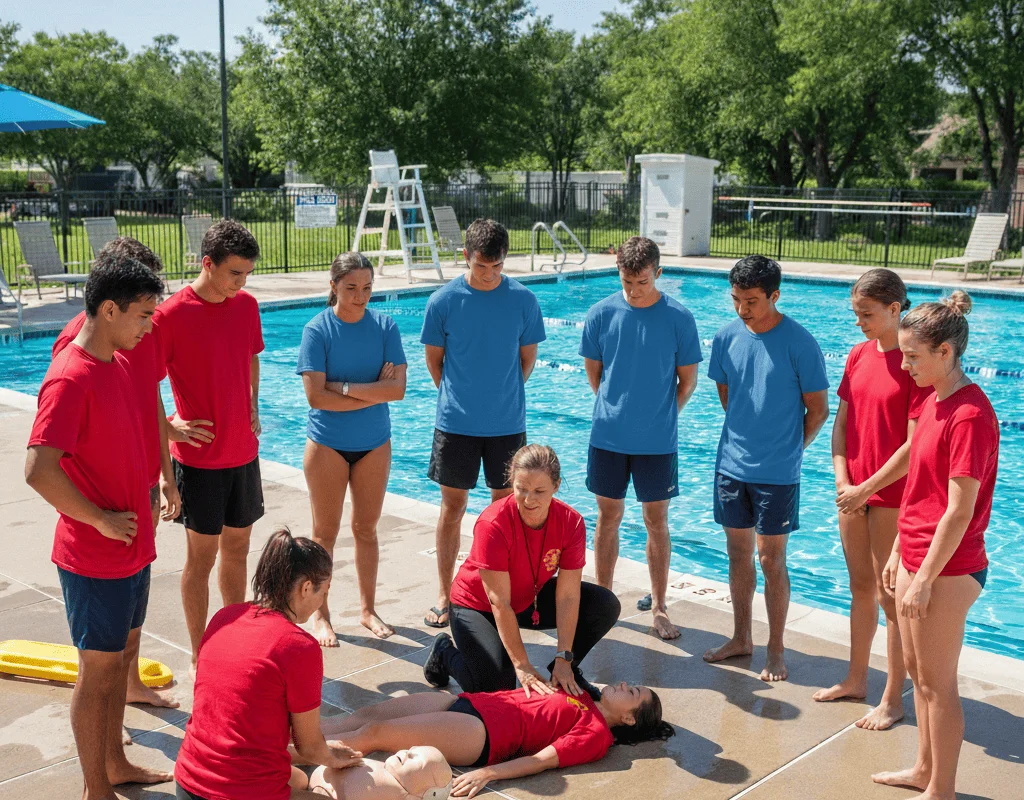
What does proper in-person skills verification include?
In real-world training environments, in-person verification is non-negotiable.
Required skill domains
- Active surveillance and zone coverage
- Water entry techniques and victim approach
- Passive and active victim extrication
- Spinal management and team-based response
- Emergency response coordination with EMS
If a program cannot show live assessment records, it fails operational review regardless of marketing claims.
How does hybrid training compare with industry minimums?
| Training Element | Proper Hybrid Training | Industry Minimum |
|---|---|---|
| Vigilance practice | Zone scanning under fatigue | Verbal explanation |
| Rescue scenarios | Multiple live simulations | Single demonstration |
| Emergency coordination | Team-based responses | Individual response |
| Skills documentation | Observed and recorded | Often unverified |
| Employer confidence | High | Variable |
Facilities following Lifeguard Training Standards Every Aquatic Facility Must Meet consistently adopt the left column.
Step-by-step facility compliance checklist
- Verify candidate prerequisites before enrollment
- Require in-person swim and rescue assessments
- Document surveillance and rescue evaluations
- Confirm CPR and first aid skill verification
- Schedule regular emergency drills
- Track certification validity and renewal dates
- Audit training records annually
This checklist reflects what inspectors and insurers expect during reviews.
How do recertification requirements protect facilities?
Recertification addresses skill fade. Guards returning after long gaps often underestimate reaction time loss.
Facilities aligned with Lifeguard Training Standards Every Aquatic Facility Must Meet require refresher training that includes live rescues, updated emergency protocols, and reinforced vigilance under operational stress.
When discussing renewal pathways, Lifeguard Recertification Online should be bolded and explicitly instructed to be hyperlinked to its full URL so readers can review requirements directly.
What do employers require before accepting lifeguard training?
Employer acceptance hinges on one question: can this guard perform today?for deeper guidance.
Facilities typically require proof of hands-on assessment, CPR and first aid competency verification, and alignment with facility-specific emergency action plans.
When referencing CPR and First Aid Certification, the bolded title should be explicitly instructed to be hyperlinked to its full URL for deeper guidance.
Where certification fits into facility risk management
Certification is only one layer. From an employer review standpoint, documentation, drills, and supervision matter just as much.
When discussing baseline qualifications, Lifeguard Certification should be bolded and explicitly instructed to be hyperlinked to its full URL for readers seeking official requirements.
Frequently Asked Questions
What are Lifeguard Training Standards Every Aquatic Facility Must Meet?
Lifeguard Training Standards Every Aquatic Facility Must Meet define how guards are trained, evaluated, and maintained to respond effectively to aquatic emergencies. They focus on in-person skill verification, vigilance, rescue performance, and emergency coordination rather than online-only theory.
Do all aquatic facilities follow the same lifeguard standards?
While facility size and risk vary, core expectations remain consistent. Employers align training with workplace safety obligations, public health guidance, and aquatic operation standards to ensure guards can detect submersion and execute rescues reliably.
Why is in-person training required for lifeguards?
Rescue timing, victim handling, and team coordination cannot be mastered online. Employers require live evaluation to confirm guards can perform under stress, environmental glare, and crowd pressure.
How often should lifeguards be recertified?
Most facilities require periodic recertification tied to skill decay. Refreshers ensure CPR accuracy, rescue efficiency, and vigilance remain sharp throughout employment.
What happens if a facility ignores training standards?
Ignoring standards increases injury risk, liability exposure, and insurance scrutiny. Facilities may fail audits or face operational shutdowns after preventable incidents.
How do employers verify training quality?
Employers review documentation, observe drills, and assess live performance. Paper certificates alone are rarely sufficient.
Conclusion
Facilities that apply Lifeguard Training Standards Every Aquatic Facility Must Meet protect patrons, staff, and operations. These standards reflect real risk, not marketing claims.
From a compliance and safety standpoint, Lifeguard Training Standards Every Aquatic Facility Must Meet remain the foundation of responsible aquatic management.
Reviewed by Jackie Stern, Lifeguard Instructor, Firefighter and EMT. Jackie Stern has taught lifeguarding for more than 20 years and works as a firefighter, EMT and swim instructor. She reviews course content, prerequisites and rescue standards against current certification requirements.
About Us
We are a nonprofit that trains and certifies in Lifeguarding, Waterfront Lifeguarding, Junior Lifeguarding, Shallow Pool Lifeguarding, Sexual Harassment Training, CPR/AED, CPR for Lifeguards, First Aid Emergency Oxygen, and swimming lessons.
© Copyright American Aquatics and Safety Training. All Rights Reserved