Mon - Sat: 8:30-18:00

Last updated
Certification awarded: CPR/AED: Adult, Child, Infant, Pediatric. This is the exact title printed on your certificate. This course covers CPR and AED only and does not include First Aid certification.
CPR/AED only is the resuscitation course on its own, without a first aid component. It concentrates entirely on cardiac emergencies: recognizing them, responding to them, and using an automated external defibrillator properly on an adult, a child or an infant.
Take this version when your requirement names CPR and AED specifically and does not mention first aid. If your requirement names both, the course you want is CPR/AED, Advanced First Aid, which covers them in one sitting.
Cardiac emergencies in detail
Because nothing competes for time in this version, the cardiac content is covered thoroughly:
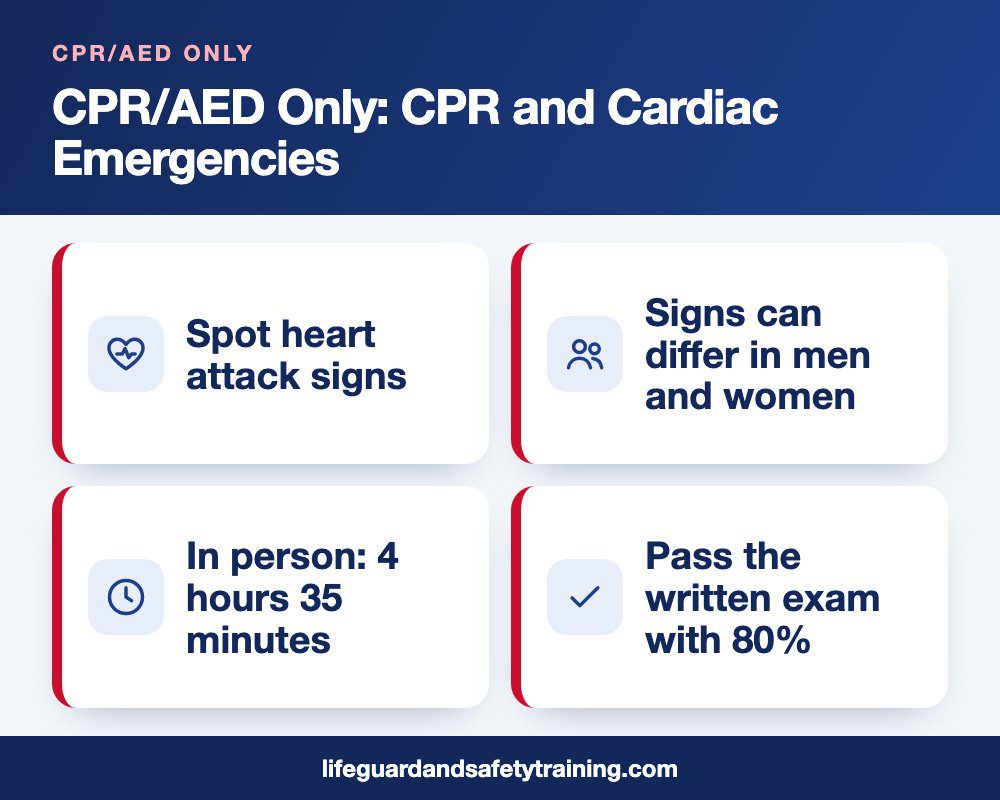
- Recognition. The signs and symptoms of a heart attack, and how those signs commonly differ between men and women, a difference that costs lives when it is not known.
- The cardiac chain of survival, taught for adults and then separately for infants and children, because the two chains are not the same.
- Cardiac arrest: what it is, how it differs from a heart attack, when to start CPR and when to stop.
- CPR treatment protocols and one-rescuer CPR for adults, children and infants.
- Two-rescuer CPR for all three age groups, including changeover.
- The AED: use on an adult, use on a child or infant, the rules governing its use, and how a unit is maintained, including keeping two sets of unexpired sealed pads.
- CPR with a bag-valve-mask, and CPR/AED with a bag-valve-mask.
Airway and breathing are included as far as resuscitation requires: monitoring airway, breathing and circulation, breathing emergencies, rescue breathing with a resuscitation mask, and conscious and unconscious choking relief for adults, children and infants. What is not included is the wider first aid syllabus: bleeding, burns, fractures, allergic reactions and the rest.
How long does this CPR course take, and what formats are offered?
This is the shortest route to a current CPR and AED certificate, in two formats.
- In person: 4 hours 35 minutes (275 minutes) from start to finish, including a 10-minute skills examination and a 20-minute written examination.
- Blended: the knowledge portion is completed online in your own time, followed by 2 hours 50 minutes (170 minutes) of in-person instruction, skills practice, skills evaluation and the written examination.
The skills evaluation is always conducted in person, face to face with an instructor, on manikins and real equipment. It is never done by webcam or on a virtual manikin, and no certificate is issued on the online coursework alone. That is worth checking against any provider offering a “fully online” card. Classes are capped at ten participants per instructor so that everyone gets hands-on time; above that number a second instructor or an authorized assistant is added.
What is the passing standard for certification?
A narrower syllabus does not mean a lower bar. To certify you must attend and take part in every session, demonstrate every required skill to the instructor, and pass the written examination with a minimum score of 80 percent. If the written examination is not passed the first time, you are given the opportunity to retake it using an alternative version at no extra cost.
Your certificate names you, the course, the issue date, the expiry date, the certifying instructor and American Aquatics and Safety Training as the issuing organization. It carries an ID and a QR code so an employer can verify it online. Certification is valid for two years.
Renewal is the same course, delivered in full. Someone renewing an expiring certificate sits the same instruction, passes the same written examination at the same 80 percent standard, and completes the same skills evaluation as a first-time candidate. AAST does not run a shortened refresher, so there is no difference in content, length or standard between an initial certification and a renewal.
How do state requirements affect the wording on my certificate?
Even a CPR-only certificate can attract a state-specific line, so it is worth knowing where that appears. The course itself is built and taught from the American Aquatics and Safety Training CPR manual, and that curriculum does not change from one state to the next: the skills, the sequence, the instructional time and the passing standard are the same everywhere.
What can change is the wording printed on the certificate. The course title on every certificate AAST issues is CPR/AED: Adult, Child, Infant, Pediatric, and that title is fixed in every state. Where a state or its Department of Health requires additional wording (an approval or provider number, or a line confirming the course meets that state’s requirement), it is added on a separate line beneath the course title. The course title itself is never altered, so a certificate remains recognisable wherever it is presented.
If you are training to satisfy a specific state license, board or Department of Health rule, tell us which one when you book. We will confirm the wording that will appear on your certificate before the class runs, and add the line that state requires. Employers can check any certificate we issue through our certification verification page.
Who issues this certification?
American Aquatics and Safety Training is a not-for-profit certifying body based in New York. We write the curriculum, train and authorize the instructors, and issue the certification ourselves. Course content follows the current ILCOR consensus on science and the American Heart Association guidelines for CPR and emergency cardiovascular care. AAST is not affiliated with, and does not certify on behalf of, the American Heart Association or the American Red Cross.
Frequently asked questions
What is left out compared with the combined course?
The first aid syllabus: bleeding control, burns, fractures, allergic reactions, seizures, diabetic emergencies, poisoning and heat and cold injury. All resuscitation and AED content is present in full.
Is choking relief included?
Yes. Conscious and unconscious choking relief for adults, children and infants is part of the resuscitation syllabus and is assessed.
Will an employer accept a CPR-only certificate?
If their requirement names CPR and AED, yes. If it also names first aid, you need CPR/AED, Advanced First Aid instead.
How long is a CPR/AED only certification valid?
Two years. Renewal is the same full course.
Book this course
Get a current, verifiable CPR and AED certificate without paying for content you do not need. Open classes are published on our CPR/AED class schedule, and we also run this course on site at your own facility on request. For group bookings and on-site scheduling, contact our team.
Reviewed by Jackie Stern, Lifeguard Instructor, Firefighter and EMT. Jackie Stern has taught lifeguarding for more than 20 years and works as a firefighter, EMT and swim instructor. She reviews course content, prerequisites and rescue standards against current certification requirements.