Mon - Sat: 8:30-18:00

The AAST Pool Operator course trains the people who run public and semi-public pools, spas and spray grounds: hotel and apartment maintenance staff, aquatic directors, park and recreation crews, school and camp facility managers, and pool service technicians. It is a hybrid course. You learn the theory online at your own pace, then prove your skills at one in-person session with an AAST instructor and pass a proctored final exam. Graduates earn an AAST Pool Operator certificate valid for 5 years.
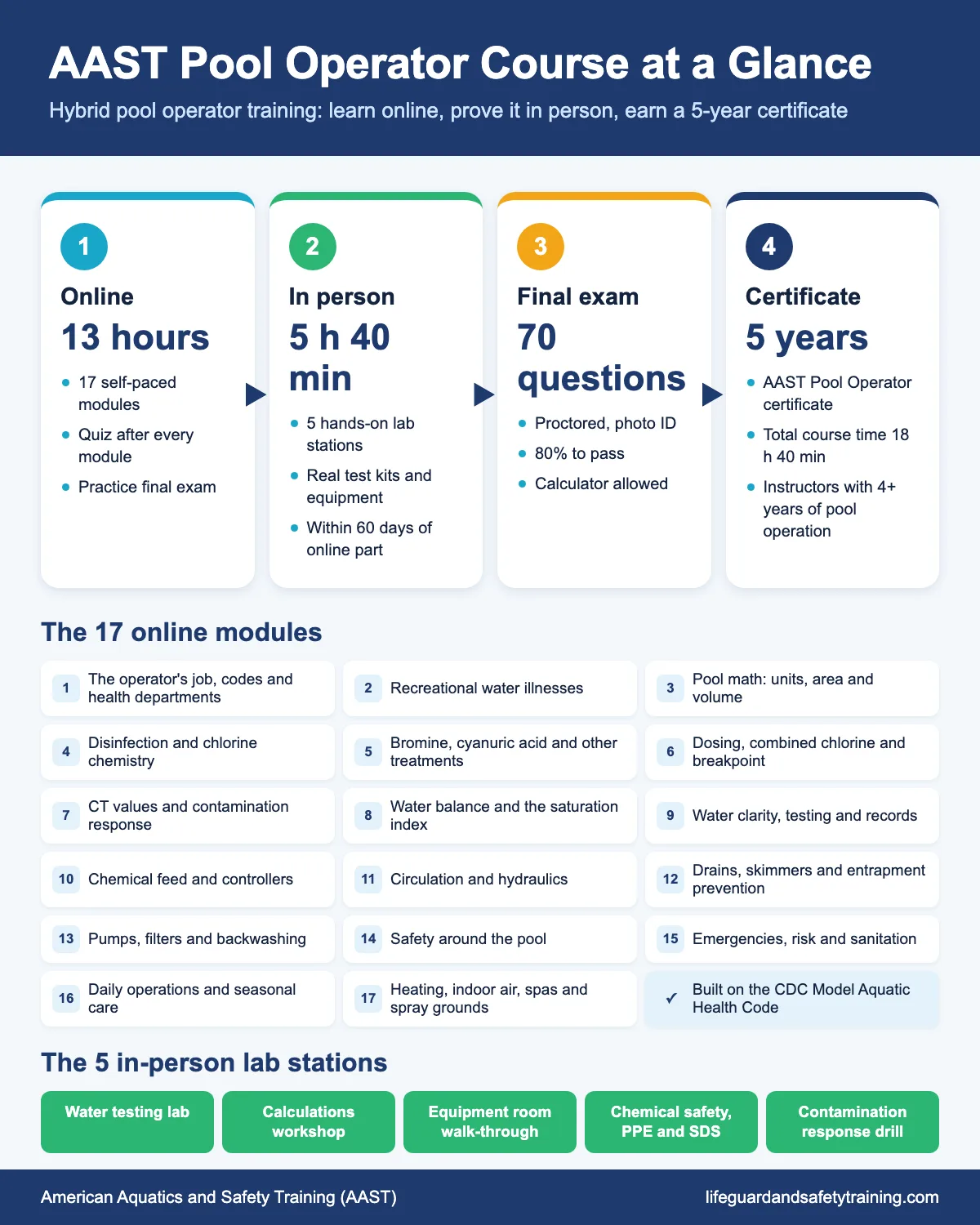
Pool operator course at a glance
| Format | Hybrid: online modules plus one in-person session |
|---|---|
| Total time | 18 hours 40 minutes (13 hours online, 5 hours 40 minutes in person) |
| Online part | 17 self-paced modules, a quiz after each module and a practice final exam |
| In-person part | 5 hands-on lab stations and the proctored final exam, within 60 days of finishing the online part |
| Final exam | 70 multiple-choice questions, 80% to pass, photo ID required, basic calculator allowed |
| Certificate | AAST Pool Operator certificate, valid for 5 years |
| Standard | Built on the CDC Model Aquatic Health Code (MAHC), 5th edition, operator training topics in section 6.1 |
What you learn: the 17 online modules
- The pool operator’s job: codes, health departments, permits, inspections and your legal duties.
- Recreational water illnesses: how germs spread in pools and how operators prevent outbreaks.
- Pool math: units, surface area, volume, turnover and flow rate.
- Disinfection and chlorine chemistry: free and combined chlorine, pH and how chlorine works.
- Bromine, cyanuric acid and other treatments.
- Dosing, combined chlorine and breakpoint chlorination.
- CT values and contamination response: what to do after a fecal or vomit incident.
- Water balance and the saturation index.
- Water clarity, testing and records: test kits, test frequency and daily logs.
- Chemical feed, controllers and secondary disinfection (UV and ozone).
- Circulation and hydraulics.
- Drains, gutters, skimmers and entrapment prevention (VGB Act requirements).
- Pumps, filters and backwashing.
- Safety around the pool: barriers, signs, depth markings, lifeguard and safety equipment.
- Emergencies, risk management and facility sanitation.
- Daily operations, maintenance and seasonal care: opening, closing and winterizing.
- Heating, indoor air quality, spas and spray grounds.
The in-person session: 5 hands-on lab stations
At the in-person session you practice the work an inspector expects you to do correctly, with an instructor checking each skill:
- Water testing lab: free and total chlorine, pH, alkalinity, calcium hardness and cyanuric acid with real test kits.
- Calculations workshop: volume, turnover, filter rate, chemical doses and the saturation index.
- Equipment room walk-through: pumps, filters, gauges, flow meters and chemical feeders.
- Chemical safety, PPE and SDS: safe storage, handling and personal protective equipment.
- Contamination response drill: closing the pool, raising chlorine and timing the reopening.
The session ends with the proctored 70-question final exam. You need 80% to pass. Bring a government-issued photo ID, a basic non-programmable calculator and closed-toe shoes.
Your state and local pool code
Pool operator requirements are set by each state, and often by the county or city health department. The course teaches the Model Aquatic Health Code and explains how to find and follow the code that applies to your pool. Where a state sets its own rule, such as New York’s and New Jersey’s operator requirements, the course explains that state’s rule as well.
AAST submits the course to state and local health departments for review. Before you enroll, check with your local health department that it accepts this course for your pool. Our team can help you find the right office.
Who teaches the course
Every AAST Pool Operator Instructor has at least 4 years of pool operation experience and completes AAST’s 600-minute Pool Operator Instructor course, including a supervised teaching evaluation, before teaching on their own.
Group and on-site training
Hotels, apartment communities, camps, schools, YMCAs and parks departments can book the in-person session for a group of staff at their own facility. Contact us or call (800) 670-3391 for dates and group pricing.
Pool operator course FAQ
How long is the pool operator course?
18 hours 40 minutes in total: about 13 hours online in 17 self-paced modules, and a 5 hour 40 minute in-person session that includes the hands-on labs and the final exam.
Can I take the pool operator course fully online?
No. The theory is online, but the water testing, equipment and chemical safety skills and the final exam are done in person with an instructor. That hands-on part is what many health departments look for.
How long is the certificate valid?
The AAST Pool Operator certificate is valid for 5 years. Some states and local health departments require renewal more often; follow your local code.
What score do I need to pass?
80% on the proctored 70-question final exam, plus completion of all online modules and the in-person lab stations.
Is this the same as a CPO certification?
No. CPO is another organization’s credential. The AAST Pool Operator course is AAST’s own course, built on the CDC Model Aquatic Health Code. Ask your health department which courses it accepts.
Who needs pool operator training?
Anyone responsible for the water quality, equipment or safety of a public or semi-public pool or spa: hotels, motels, apartment and condominium pools, health clubs, schools, camps, municipal pools and pool service companies.
More about pool operator certification
Training a group? Camps, schools, employers and facilities can request a quote for group pool operator training, with group rates for your whole team.