Mon - Sat: 8:30-18:00

- Course
- CPR and AED
- Bloodborne Pathogens Training
- Babysitting Training
- First Aid
- Lifeguard Instructor
- Sexual Harassment Training
- Aquatic Supervisor
- Pool Activity Leader
- Emergency Oxygen
- Pool Operator
- Waterfront Lifeguarding
- Lifeguard Certification
- Shallow Water Lifeguard
- Waterfront Lifeguard
- Aquatic Attraction Lifeguard
- Surf Lifeguard
- Wilderness Lifeguard
- Junior Lifeguard
- Lifeguard Crash Course
- Lifeguard Recertification
- Lifeguard Management
- Aquatic Supervisor
- First Aid
- Water Swimming Instructor
- Pool Lifeguard
- Pediatric First Aid and CPR
- Aquatic Safety Consulting
- Aquatic Safety Award
- Lifeguard Training
- Alabama
- Alaska
- Arkansas
- Arizona
- California
- Colorado
- Connecticut
- Delaware
- District Of Columbia
- Florida
- Georgia
- Guam
- Hawaii
- Idaho
- Illinois
- Indiana
- Iowa
- Kansas
- Kentucky
- Louisiana
- Maine
- Maryland
- Massachusetts
- Michigan
- Minnesota
- Mississippi
- Missouri
- Montana
- Nebraska
- Nevada
- New Hampshire
- New Jersey
- New Mexico
- New York
- North Carolina
- North Dakota
- Ohio
- Oklahoma
- Oregon
- Pennsylvania
- Puerto Rico
- Rhode Island
- South Carolina
- South Dakota
- Tennessee
- Texas
- Utah
- Vermont
- Virginia
- Washington
- West Virginia
- Wisconsin
- Wyoming
- Location
- Become an Instructor
- Verification
- Blog
- Contact Us
- Instructor Login
- My account
Bloodborne Pathogens Training for Custodial Staff
Last updated
Blood Exposure Risks in Environmental Services.
Housekeeping · Laundry · Biohazard remediation · Waste handling
Bloodborne pathogens training for custodial staff covers the people who arrive after the incident. They rarely witness what happened, they are often told very little about it, and they handle the material for longer than anyone else did.
That is precisely why 29 CFR 1910.1030 covers this work, and why cleaning staff are among the most frequently untrained groups an inspector finds.
Which bloodborne pathogens course do I need?
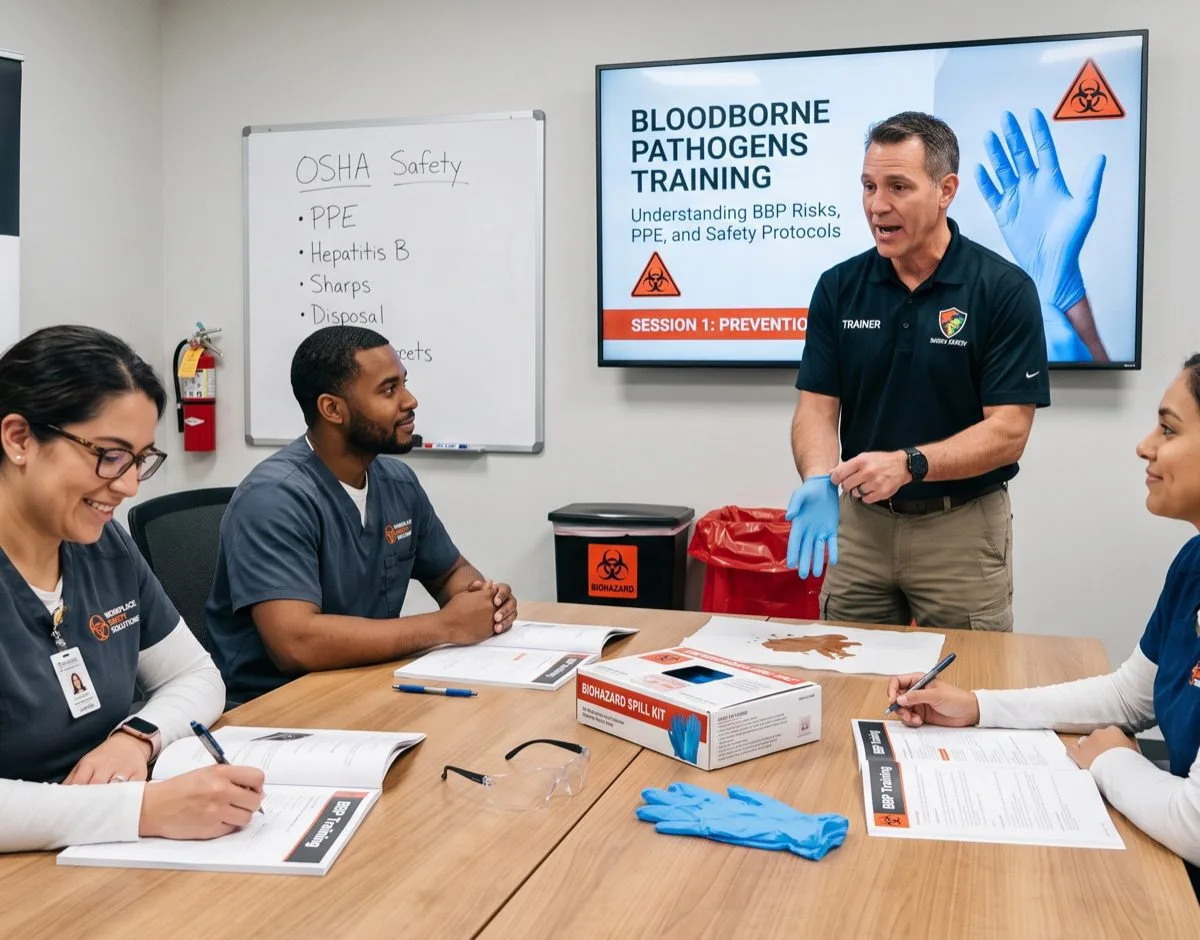
This work has its own course: Bloodborne Pathogens Training for Custodial Staff, available online or in person. It carries 300 minutes, five hours, of instruction and a 50-question examination at an 80 percent passing score. It covers everything 29 CFR 1910.1030 requires of a training program, and adds sharps in the waste stream, handling contaminated laundry, picking up broken glass without using your hands, disinfectant contact time, and who is responsible for training and records when the labor is supplied by a contractor.
The five-hour length is set to meet the longest state training requirement, so it also satisfies the shorter ones. Certification is valid two years. Note that 1910.1030 separately requires covered employees to be retrained at least annually, so a two-hour update course is offered for the intervening year where a jurisdiction requires annual training.
Email support@lifeguardandsafetytraining.com to schedule the in person class. Full course details are on our Bloodborne Pathogens Training page.
Who must take bloodborne pathogens training?
Job duties decide this, not job title. In environmental services and maintenance that normally includes:
- Hospital and clinical janitorial, housekeeping and laundry workers handling biohazard waste
- Crime scene cleanup technicians and biohazard remediation crews
- Regulated medical waste handlers and transporters
- Facility maintenance personnel assigned to clean up blood or bodily fluid spills in commercial or industrial settings
- School, gym, hotel and transit cleaning staff with spill response duties
- Supervisors who assign spill response and keep the training records
A cleaner with no assigned spill or waste duty may sit outside the standard. In practice, most cleaning contracts assign exactly that duty, which brings the worker inside it.
Where does exposure to bloodborne pathogens happen for custodial staff?
Sharps in the waste stream. Needles in general refuse bags, in linen, and pushed into the sides of bins. Compacting a bag by hand is how most of these injuries happen, and it is the single habit worth training out.
Laundry. Contaminated linen must be handled as little as possible, bagged where it is used, and never sorted or rinsed in the area of use. Wet linen needs leak-resistant bagging.
Spill response. Broken glass and sharps are picked up with tongs, a brush and pan or forceps, never with gloved hands. Gloves stop contamination, not punctures.
Disinfectant contact time. The most common failure in cleaning is wiping a surface dry too soon. A product only does what its label claims if the surface stays visibly wet for the stated contact time.
Remediation and unattended death work. Longer exposure, heavier soiling and confined spaces, plus respiratory protection considerations that go beyond this standard.
What your employer has to provide
- Gloves in the right sizes, plus gowns, eye protection and face protection where splashing is foreseeable
- Puncture-resistant, labelled and leak-proof sharps containers, close to where sharps are found
- A written exposure control plan naming who cleans what, and reviewed at least annually
- Hepatitis B vaccination offered within 10 working days of initial assignment, at no cost
- Training at no cost and during working hours, before the work begins
Contract and agency staff are covered on the same terms. Where a contractor supplies the labor, the host employer and the contractor need to agree in writing who trains, who supplies PPE and who keeps the records, because both can be cited.
Questions
Yes. The standard follows the exposure, not the building. Schools, gyms, hotels, transit, offices and industrial sites all fall under it wherever staff are assigned to clean up blood or other potentially infectious material.
If clean-up is part of the assigned duties, it is a reasonably anticipated exposure and training is required. Rarity does not remove the duty; it only makes an untrained response more likely to go wrong.
Only with the right process: contain, remove sharps mechanically, apply an EPA-registered disinfectant effective against HBV and HIV, observe the full contact time, then dispose of the material as regulated waste where volume requires it.
Whoever employs them, but the host employer should confirm it has happened and keep evidence. In a joint arrangement both parties can be cited, so the exposure control plan needs to say plainly who does what.
Enroll in our bloodborne pathogens training for custodial staff, $25, five hours, online or in person, certification valid two years.
Training a group? Camps, schools, employers and facilities can request a quote for group bloodborne pathogens training, with group rates for your whole team.
About Us
We are a nonprofit that trains and certifies in Lifeguarding, Waterfront Lifeguarding, Junior Lifeguarding, Shallow Pool Lifeguarding, Sexual Harassment Training, CPR/AED, CPR for Lifeguards, First Aid Emergency Oxygen, and swimming lessons.
© Copyright American Aquatics and Safety Training. All Rights Reserved