Mon - Sat: 8:30-18:00

Last updated
Bls class for healthcare professionals
A Basic Life Support class covers initial assessment, airway management, rescue breathing and chest compressions for healthcare providers and workplace responders. It goes deeper than a standard CPR class and assumes professional use.
Getting ready for BLS? Try the free BLS practice test: 25 questions, every answer explained.
Certification awarded: CPR/AED: Adult, Child, Infant, Pediatric. This is the exact title printed on your certificate, and it is the same in every state.
Basic Life Support for healthcare providers is the version of our CPR/AED course written for people who respond to a cardiac arrest as part of a clinical team rather than as a lone bystander. It covers the same core resuscitation science as every AAST CPR course, but it spends its time where a healthcare provider actually needs it: two-rescuer sequences, airway management with a bag-valve-mask, and clean handovers to the emergency medical services system.
If you work in a hospital, a clinic, a dental practice, a nursing or residential care home, a dialysis or imaging unit, a school health office or an urgent care setting, this is the CPR/AED course intended for you.
What makes the healthcare provider version different
A member of the public performing CPR is usually alone, working on an adult, and waiting for help to arrive. A healthcare provider is usually not alone. The provider course is weighted accordingly:
- Two-rescuer CPR for adults, children and infants, including compressor changeover without breaking the compression rhythm.
- CPR with a bag-valve-mask, taught as a dedicated skills block, then again in combination with the AED. These are the two longest practical segments in the course.
- Paediatric and infant resuscitation as core content rather than an appendix, including the separate cardiac chain of survival for infants and children.
- Working inside the EMS system: rescuer responsibilities, what the emergency medical services system expects at handover, and how to record and report an incident.
- The legal frame you work in: consent and implied consent, duty to act, standard of care, negligence, abandonment, refusal of care and the patient’s right to privacy.
How long does this CPR course take, and what formats are offered?
Healthcare employers usually need staff certified without losing a full shift, so this course runs in two formats and you can mix them across a team.
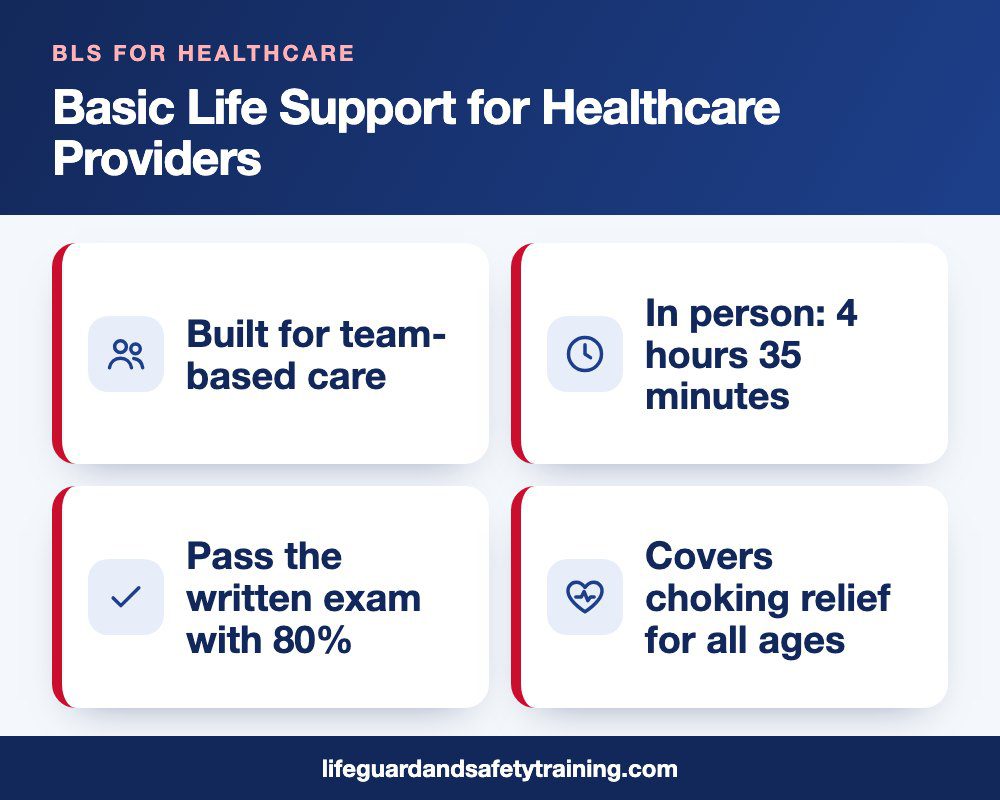
- In person: 4 hours 35 minutes (275 minutes) from start to finish, including a 10-minute skills examination and a 20-minute written examination.
- Blended: the knowledge portion is completed online in your own time, followed by 2 hours 50 minutes (170 minutes) of in-person instruction, skills practice, skills evaluation and the written examination.
The skills evaluation is always conducted in person, face to face with an instructor, on manikins and real equipment. It is never done by webcam or on a virtual manikin, and no certificate is issued on the online coursework alone. That is worth checking against any provider offering a “fully online” card. Classes are capped at ten participants per instructor so that everyone gets hands-on time; above that number a second instructor or an authorized assistant is added.
Skills you will be assessed on
Assessment is practical. You will be asked to demonstrate an initial assessment and scene size-up; monitoring airway, breathing and circulation; rescue breathing with a resuscitation mask, including mask-to-nose and mask-to-stoma variations; conscious and unconscious choking relief for an adult, a child and an infant; one-rescuer and two-rescuer CPR across all three age groups; correct AED use on an adult and on a child or infant; and CPR with a bag-valve-mask, alone and with the AED in use. Special situations are covered too: dentures, and suspected injury to the head, neck, chest or back, including the H.A.I.N.E.S. recovery position.
What is the passing standard for certification?
Certification is awarded on performance, not attendance. To certify you must attend and take part in every session, demonstrate every required skill to the instructor, and pass the written examination with a minimum score of 80 percent. If the written examination is not passed the first time, you are given the opportunity to retake it using an alternative version at no extra cost.
Your certificate names you, the course, the issue date, the expiry date, the certifying instructor and American Aquatics and Safety Training as the issuing organization. It carries an ID and a QR code so an employer can verify it online. Certification is valid for two years.
Renewal is the same course, delivered in full. Someone renewing an expiring certificate sits the same instruction, passes the same written examination at the same 80 percent standard, and completes the same skills evaluation as a first-time candidate. AAST does not run a shortened refresher, so there is no difference in content, length or standard between an initial certification and a renewal.
How do state requirements affect the wording on my certificate?
Healthcare employers and licensing boards are the most likely to ask for specific wording on a card, so it is worth being precise about what does and does not vary. The course itself is built and taught from the American Aquatics and Safety Training CPR manual, and that curriculum does not change from one state to the next: the skills, the sequence, the instructional time and the passing standard are the same everywhere.
What can change is the wording printed on the certificate. The course title on every certificate AAST issues is CPR/AED: Adult, Child, Infant, Pediatric, and that title is fixed in every state. Where a state or its Department of Health requires additional wording (an approval or provider number, or a line confirming the course meets that state’s requirement), it is added on a separate line beneath the course title. The course title itself is never altered, so a certificate remains recognisable wherever it is presented.
If you are training to satisfy a specific state license, board or Department of Health rule, tell us which one when you book. We will confirm the wording that will appear on your certificate before the class runs, and add the line that state requires. Employers can check any certificate we issue through our certification verification page.
Who issues this certification?
American Aquatics and Safety Training is a not-for-profit certifying body based in New York. We write the curriculum, train and authorize the instructors, and issue the certification ourselves. Course content follows the current ILCOR consensus on science and the American Heart Association guidelines for CPR and emergency cardiovascular care. AAST is not affiliated with, and does not certify on behalf of, the American Heart Association or the American Red Cross.
What Basic Life Support is, and who needs it
Basic life support is the care that keeps someone alive until they reach definitive medical treatment. It is defined by what it protects (a clear airway, breathing and circulation) rather than by any single technique, and it is the level of care expected of a first responder, a public safety professional or a healthcare provider before a patient reaches hospital.
For many clinical roles it is not optional. Employers routinely require current BLS-level certification of nurses and nursing assistants, emergency medical technicians and paramedics, physician assistants, respiratory therapists, dental staff, medical and nursing students, and therapy and imaging staff, often as a condition of hire rather than something to complete afterwards. Requirements are set by the employer, the facility or the state licensing board, so check which certification yours will accept before booking.
The reason the AED matters so much here is simple: defibrillation is time-critical. Published resuscitation research has consistently found that a person who suffers cardiac arrest in a public place is substantially more likely to survive when a bystander uses an AED before the emergency services arrive. Compressions alone buy time; the defibrillator is what restores a shockable rhythm, which is why this course spends two of its longest practical blocks on the AED and on using it alongside a bag-valve-mask.
Frequently asked questions
Is basic life support for healthcare providers the same as a BLS certification?
It covers the same body of skills: high-quality compressions, ventilation, AED use and team resuscitation for adults, children and infants. The certificate is issued by AAST and titled CPR/AED: Adult, Child, Infant, Pediatric. If your employer requires a card issued specifically by the American Heart Association, ask them to confirm before you book, because we are not an AHA training center and do not issue AHA cards.
Can I complete it entirely online?
No. The knowledge portion can be completed online in the blended format, but the skills evaluation is always in person with an instructor, and no certificate is issued on the online coursework alone.
How long does the certification last?
Two years. Renewal is the full course again; there is no shortened refresher.
Do you train whole departments on site?
Yes. We run this course at your facility, with classes capped at ten participants per instructor. Group and on-site training is arranged on request.
Book this course
Certify your clinical staff in Basic Life Support with a provider that issues, verifies and stands behind its own certification. Open classes are published on our CPR/AED class schedule, and we also run this course on site at your own facility on request. For group bookings and on-site scheduling, contact our team.
Reviewed by Jackie Stern, Lifeguard Instructor, Firefighter and EMT. Jackie Stern has taught lifeguarding for more than 20 years and works as a firefighter, EMT and swim instructor. She reviews course content, prerequisites and rescue standards against current certification requirements.