Mon - Sat: 8:30-18:00

- Course
- CPR and AED
- Bloodborne Pathogens Training
- Babysitting Training
- First Aid
- Lifeguard Instructor
- Sexual Harassment Training
- Aquatic Supervisor
- Pool Activity Leader
- Emergency Oxygen
- Pool Operator
- Waterfront Lifeguarding
- Lifeguard Certification
- Shallow Water Lifeguard
- Waterfront Lifeguard
- Aquatic Attraction Lifeguard
- Surf Lifeguard
- Wilderness Lifeguard
- Junior Lifeguard
- Lifeguard Crash Course
- Lifeguard Recertification
- Lifeguard Management
- Aquatic Supervisor
- First Aid
- Water Swimming Instructor
- Pool Lifeguard
- Pediatric First Aid and CPR
- Aquatic Safety Consulting
- Aquatic Safety Award
- Lifeguard Training
- Alabama
- Alaska
- Arkansas
- Arizona
- California
- Colorado
- Connecticut
- Delaware
- District Of Columbia
- Florida
- Georgia
- Guam
- Hawaii
- Idaho
- Illinois
- Indiana
- Iowa
- Kansas
- Kentucky
- Louisiana
- Maine
- Maryland
- Massachusetts
- Michigan
- Minnesota
- Mississippi
- Missouri
- Montana
- Nebraska
- Nevada
- New Hampshire
- New Jersey
- New Mexico
- New York
- North Carolina
- North Dakota
- Ohio
- Oklahoma
- Oregon
- Pennsylvania
- Puerto Rico
- Rhode Island
- South Carolina
- South Dakota
- Tennessee
- Texas
- Utah
- Vermont
- Virginia
- Washington
- West Virginia
- Wisconsin
- Wyoming
- Location
- Become an Instructor
- Verification
- Blog
- Contact Us
- Instructor Login
- My account
Bloodborne Pathogens Training for Laboratory Workers
Last updated
Blood Exposure Risks in Research and Laboratory Settings
Research laboratories · Biotech · Pharmaceutical · Cell culture
Bloodborne pathogens training for laboratory workers is where 29 CFR 1910.1030 is at its most specific. Human cell lines, blood products and other potentially infectious material are covered whether or not anyone in the building treats a patient, and research laboratories carry requirements the rest of the standard does not impose.
The point people miss: an established, commercially sourced human cell line is still covered. OSHA treats human cell lines as potentially infectious unless they have been documented and characterised as free of bloodborne pathogens.
Which bloodborne pathogens course do I need?
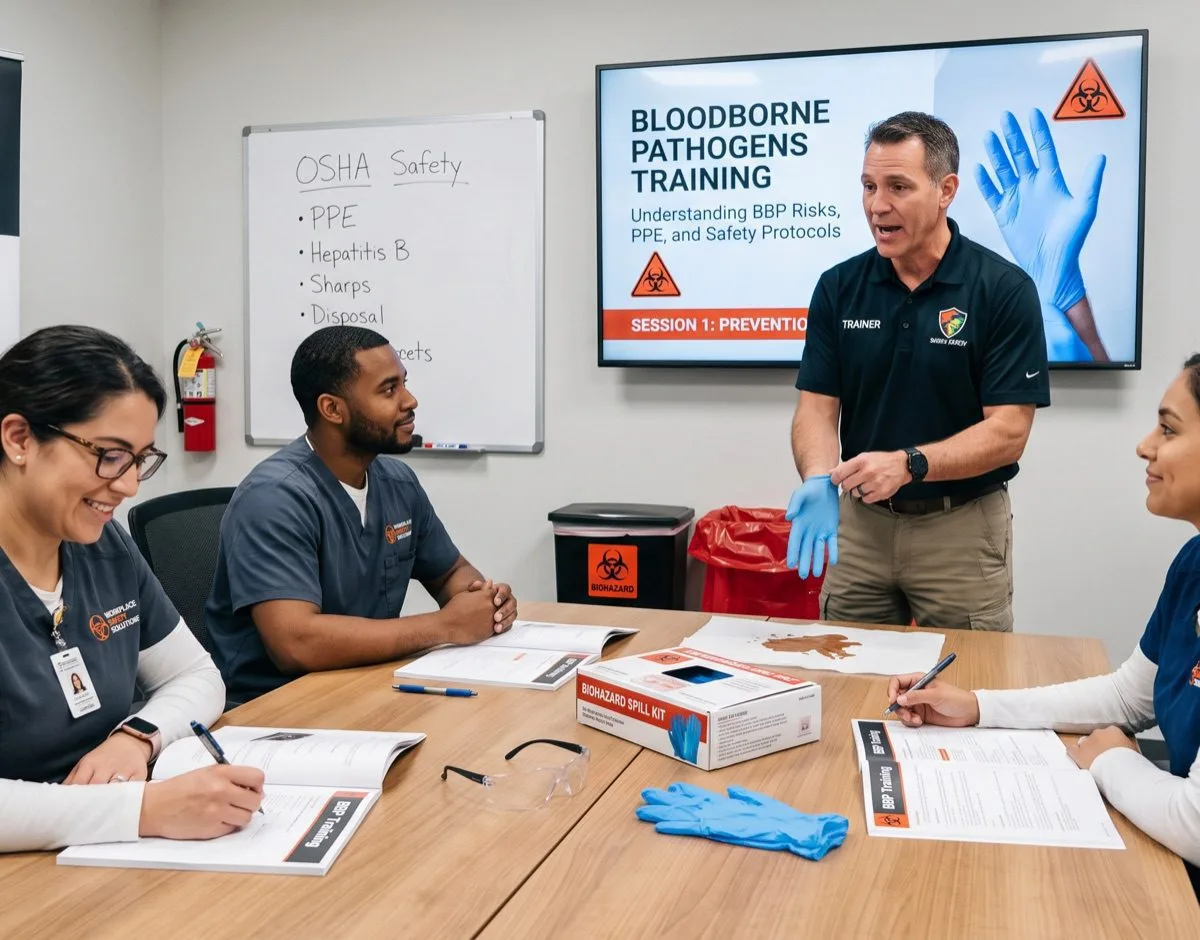
This work has its own course: Bloodborne Pathogens Training for Laboratory Workers, available online or in person. It carries 300 minutes, five hours, of instruction and a 50-question examination at an 80 percent passing score. It covers everything 29 CFR 1910.1030 requires of a training program, and adds human cell lines and when they are covered, sharps and glass substitution, centrifuge and pipetting aerosols, and the paragraph (e) duties that apply to HIV and HBV research laboratories and production facilities.
The five-hour length is set to meet the longest state training requirement, so it also satisfies the shorter ones. Certification is valid two years. Note that 1910.1030 separately requires covered employees to be retrained at least annually, so a two-hour update course is offered for the intervening year where a jurisdiction requires annual training.
Email support@lifeguardandsafetytraining.com to schedule the in person class. Full course details are on our Bloodborne Pathogens Training page.
Who must take bloodborne pathogens training?
Job duties decide this, not job title. In life sciences and research that normally includes:
- Research laboratory staff, technicians and postdoctoral researchers
- Biotech and pharmaceutical personnel handling human cell lines, blood products or OPIM
- Clinical trial and biorepository staff processing human specimens
- Phlebotomists and specimen processors working to a research protocol
- Glasswash, autoclave and waste staff handling laboratory material
- Facilities and engineering staff servicing equipment inside the laboratory
Support staff who never enter the laboratory are usually outside the standard. Anyone who services a centrifuge, a biosafety cabinet or a waste stream inside it generally is not.
Where does exposure to bloodborne pathogens happen for laboratory workers?
Sharps. Needles, scalpels, and the one people forget, broken glass Pasteur pipettes and slides. Plastic substitutes remove the hazard entirely and are the expected engineering control.
Aerosols. Centrifuge failures, uncapping tubes, vortexing and pipetting all generate aerosols. Sealed rotors and safety cups opened inside a biosafety cabinet are the controls that matter.
Cell culture. Human primary cells and established lines, and any culture medium containing human serum.
Mucous membrane and non-intact skin contact. Splashes to the eye during decanting are a recognized transmission route and the reason face protection is specified rather than suggested.
The extra requirements for research laboratories
Where a facility is an HIV or HBV research laboratory or production facility, paragraph (e) of the standard adds duties that do not apply to an ordinary workplace:
- A biosafety manual, reviewed and enforced, with defined entry restrictions
- Demonstrated proficiency in standard microbiological practices before working with the agent
- A training program in handling human pathogens, with supervised experience for staff without prior experience
- Hepatitis B vaccination offered to all workers in HBV facilities
- Containment equipment, hand-washing and eyewash facilities, and specified engineering controls
Institutional biosafety requirements, NIH guidelines and any state-plan standard sit alongside this rather than replacing it. Confirm what applies with your biosafety officer.
Questions
Yes, unless the line has been documented and characterised as free of bloodborne pathogens. OSHA’s position is that human cell lines are treated as potentially infectious by default, so the burden is on the employer to document otherwise.
Material properly fixed and inactivated is generally outside the standard, but the handling before fixation is not, and neither is the sharps hazard. Assess the whole workflow rather than the end state.
Bloodborne pathogens under this standard means human pathogens. Non-human primate material carries its own serious hazards and is managed under biosafety rules rather than 1910.1030.
Yes, at initial assignment and at least annually after that, plus additional training whenever a change in tasks or procedures affects exposure. A new protocol or a new agent is exactly such a change.
Enroll in our bloodborne pathogens training for laboratory workers, $25, five hours, online or in person, certification valid two years.
Training a group? Camps, schools, employers and facilities can request a quote for group bloodborne pathogens training, with group rates for your whole team.
About Us
We are a nonprofit that trains and certifies in Lifeguarding, Waterfront Lifeguarding, Junior Lifeguarding, Shallow Pool Lifeguarding, Sexual Harassment Training, CPR/AED, CPR for Lifeguards, First Aid Emergency Oxygen, and swimming lessons.
© Copyright American Aquatics and Safety Training. All Rights Reserved