Mon - Sat: 8:30-18:00

Last updated
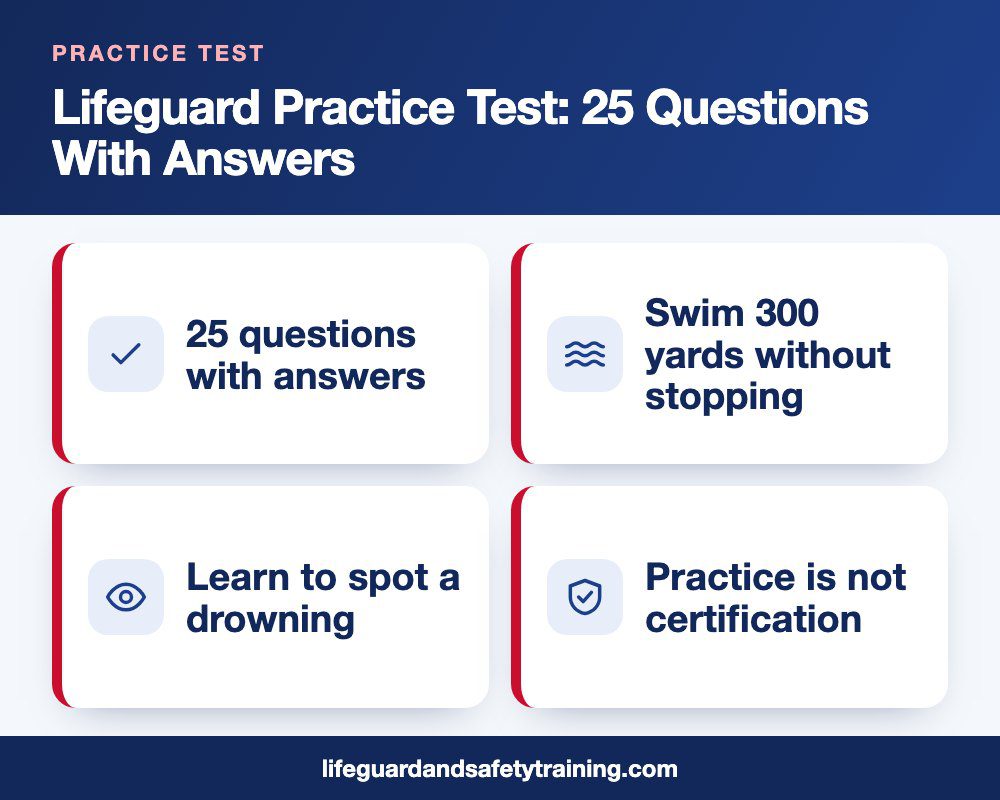
Check what you know before your lifeguard course or written exam. These 25 questions cover the prerequisite swim test, spotting a drowning, rescues, suspected spinal injuries in the water, emergency plans and CPR for drowning victims.
- 25 questions
- About 10 minutes
- Every answer explained
- No sign-up
Pick an answer to see right away whether it is right and why. Your score updates as you go, and you can start over at any time.
25 lifeguard practice questions
Question 1 of 25
Before an AAST lifeguard course begins, how far must you swim without stopping, using front crawl or breaststroke?
Show answer
Answer: C. 300 yards. AAST's prerequisite is a 300-yard continuous swim using front crawl or breaststroke, and it happens before training starts. Practice the full distance without stopping before you arrive. Confirm the details for your course when you book. (AAST)
Question 2 of 25
In AAST's prerequisite test, how long must you tread water using only your legs?
Show answer
Answer: B. 2 minutes. AAST's prerequisite includes treading water for 2 minutes using only your legs, with no help from your hands. It is checked before training starts, so practice it ahead of time. (AAST)
Question 3 of 25
In AAST's timed event, you swim 20 yards, dive 7 to 10 feet for a 10-pound object, return, and exit; what is the time limit?
Show answer
Answer: A. Under 1 minute 40 seconds. AAST's timed event must be finished, including the exit from the pool, in under 1 minute 40 seconds. Practice with a real 10-pound object, because carrying it slows the swim back. (AAST)
Question 4 of 25
To earn AAST lifeguard certification, what written exam score do you need, and what else must you pass?
Show answer
Answer: D. 80 percent, and you must also pass every required skill. AAST's written exam pass mark is 80 percent. You must also pass every required skill, and a strong written score cannot make up for a failed rescue. (AAST)
Question 5 of 25
From your lifeguard station, how much of your assigned zone should you be able to see?
Show answer
Answer: B. All of it, including the water below the surface. The CDC's Model Aquatic Health Code says zones must be set up so the lifeguard can view the entire assigned area. It even requires polarized sunglasses when glare blocks the view below the surface. (CDC Model Aquatic Health Code)
Question 6 of 25
While you are watching your zone, which of these breaks a basic lifeguard surveillance rule?
Show answer
Answer: C. Checking messages on your phone in between your scans. The CDC's Model Aquatic Health Code bars lifeguards on surveillance from having phones, reading materials or music players on them or at their station, and from social conversations. (CDC Model Aquatic Health Code)
Question 7 of 25
What can a distressed swimmer still do that an active drowning victim cannot?
Show answer
Answer: A. Move arms and legs on purpose to keep the mouth up. Frank Pia described distressed swimmers as still able to move their arms and legs on purpose to keep their mouth up. In the instinctive drowning response that control is lost, and the person cannot call or wave for help. (Carballo-Fazanes et al., 2020)
Question 8 of 25
Which description best fits a passive drowning victim?
Show answer
Answer: D. Face down and not moving, or sunk below the surface. Passive victims are often face down with no movement, or have sunk below the surface. With no struggle to catch your eye, they are easy to miss unless you scan the bottom too. (Comp et al., 2023)
Question 9 of 25
Why do people in the instinctive drowning response rarely shout or wave for help?
Show answer
Answer: B. Yelling or lifting an arm costs air and support they need. Breathing comes first. Yelling pushes out air that helps them float, and lifting an arm takes away support that keeps the mouth up, so drowning is often silent. (Carballo-Fazanes et al., 2020)
Question 10 of 25
While scanning, you see a child upright in deep water, head tilted back, mouth at the surface, arms pressing down at her sides, going nowhere; what is happening?
Show answer
Answer: C. She is an active drowning victim and needs rescue right now. Arms pressing down at the sides with no forward progress is the instinctive drowning response. Pia observed that this surface struggle lasts only about 20 to 60 seconds, so go immediately. (Carballo-Fazanes et al., 2020)
Question 11 of 25
While scanning, you notice a swimmer lying still on the bottom of the deep end; what should you do?
Show answer
Answer: B. Activate your EAP and reach the swimmer now with a surface dive. Drowning happens in seconds and is often silent, so never wait to see whether a still swimmer comes up. Signal for backup under your EAP and start the submerged rescue right away. (CDC)
Question 12 of 25
During an active victim rescue, where should your rescue tube be when you reach the victim?
Show answer
Answer: A. Between you and the victim, so the victim grabs the tube instead of you. AAST's skills test checks that the tube is always between rescuer and victim. That way the victim holds onto the tube for support, and you never become the flotation. (AAST)
Question 13 of 25
When you have a choice, why is it safer to reach an active drowning victim from behind?
Show answer
Answer: D. The victim is less likely to grab you and push you under. A panicking victim who faces you may grab you and push you under. Coming from behind, with your rescue tube ready for the victim to hold, lowers that risk. (University of Maryland)
Question 14 of 25
Why must lifeguards enforce No Diving rules where the pool is 5 feet deep or shallower?
Show answer
Answer: C. A head-first dive into shallow water can cause a spinal cord injury. The CDC's Model Aquatic Health Code requires No Diving markers where water is 5 feet or shallower and warns that head-first dives from the deck into water under 5 feet risk catastrophic spinal cord injury. (CDC Model Aquatic Health Code)
Question 15 of 25
A teen dives into the shallow end and floats face down without moving; after activating your EAP, what is your main goal in the water?
Show answer
Answer: B. Turn the teen face up, keeping the head and neck in line. Suspect a spinal injury, but the teen cannot breathe face down. Keep the head, neck and back in line as you turn the teen face up, then use a backboard with a team. (AAST)
Question 16 of 25
What does a pool's emergency action plan (EAP) lay out?
Show answer
Answer: A. Who responds, what each person does, and what equipment is needed. The CDC's Model Aquatic Health Code defines an EAP as a plan for a specific emergency that names who will respond, each person's role, and the equipment needed. Lifeguards must be trained on it. (CDC Model Aquatic Health Code)
Question 17 of 25
In a life-threatening emergency, why does the EAP have you signal other staff as soon as you start the rescue?
Show answer
Answer: D. So EMS gets called and others come to help with care. Under the CDC's Model Aquatic Health Code, the goal of an EAP in a life-threatening emergency is to activate EMS and bring other people to assist the lifeguard, such as with CPR, as soon as possible. (CDC Model Aquatic Health Code)
Question 18 of 25
A parent tells you her 6-year-old has been missing for a few minutes; where should the search start?
Show answer
Answer: A. In the water, including the bottom of every pool. A missing child could be underwater, where every second matters. Federal Pool Safely guidance says that if a child is missing, check the pool first, so search the water and the bottom before anywhere else. (Pool Safely)
Question 19 of 25
After you clear an outdoor pool for a thunderstorm, when does the National Weather Service say people can safely go back out?
Show answer
Answer: C. 30 minutes after the last lightning or thunder. The National Weather Service says to wait 30 minutes after the last lightning or thunder before going back outside. Each new rumble of thunder restarts the 30-minute wait. (National Weather Service)
Question 20 of 25
What should you put on before you care for a guest's bleeding cut?
Show answer
Answer: D. A pair of disposable medical gloves. OSHA's bloodborne pathogens standard requires gloves whenever hand contact with blood can reasonably be expected. Wash your hands as soon as you can after taking the gloves off. (OSHA bloodborne pathogens standard)
Question 21 of 25
What should you carry on duty so you can give rescue breaths without direct mouth-to-mouth contact?
Show answer
Answer: B. A resuscitation mask with a one-way valve. The CDC's Model Aquatic Health Code requires on-duty lifeguards to carry a resuscitation mask with a one-way valve and disposable gloves, in a hip pack or attached to the rescue tube. (CDC Model Aquatic Health Code)
Question 22 of 25
You pull an unresponsive teen who needs CPR out of the pool while a coworker gets the AED; how should you begin?
Show answer
Answer: A. Give 2 rescue breaths, then start chest compressions. Drowning usually stops breathing first, so getting oxygen in is the priority. The 2025 CPR guidelines say trained rescuers may begin CPR with breaths, and AAST teaches 2 breaths, then compressions, without waiting for the AED. (2025 AHA Guidelines)
Question 23 of 25
Before you place AED pads on a drowning victim's wet chest, what should you do?
Show answer
Answer: C. Remove clothing from the chest and quickly wipe it dry. Published AED steps say to remove clothing covering the chest and, if necessary, wipe the chest dry, then attach the pads to bare skin. Waiting for skin to air-dry wastes time. (American Heart Association)
Question 24 of 25
Why should you stop swimmers who hyperventilate and then hold their breath underwater for as long as they can?
Show answer
Answer: D. They can black out underwater before feeling the urge to come up. Hyperventilating and long breath-holds delay the urge to surface, so oxygen can drop until the swimmer blacks out underwater. In a CDC report, everyone who died was an advanced or expert swimmer. (CDC MMWR, 2015)
Question 25 of 25
When you fill out an incident report, what should you write?
Show answer
Answer: B. Facts about what happened and the care given, with no guesses. Incident reports should hold facts only: what you saw, heard and did. Leave out guesses about what happened, and never assign or admit blame on the form. (Aquatics International)
Ready to get certified?
When you are ready, find a lifeguard class and see dates, locations and cost. Make sure you can pass the prerequisite swim test first, and see group lifeguard training if you are training a team.
About this practice test
This is a practice test, not a certification exam. Lifeguard certification also requires showing every rescue and care skill in the water with an instructor, so a practice score can’t replace the course. Lifeguard programs differ in some details, such as whistle signals and the names of entries, so these questions stick to principles all programs share, plus AAST’s own prerequisite swim test. Prerequisites can vary by course, so confirm them when you book. AAST’s course exams use their own questions. To see how the real written exam works, read about the lifeguard written test and the lifeguard certification test.
Sources
- AAST: Lifeguard Certification Requirements
- AAST: Lifeguard Written Test
- AAST: Lifeguard Skills Test
- AAST: What You Are Actually Assessed On in a Lifeguard Certification
- CDC Model Aquatic Health Code, 2024 (5th Edition): Code
- CDC Model Aquatic Health Code, 2024 (5th Edition): Annex
- Carballo-Fazanes A, Bierens JJLM, et al. The Visible Behaviour of Drowning Persons. Int J Environ Res Public Health. 2020;17(18):6930
- Comp GB, et al. Everyday Water-Related Emergencies: A Didactic Course Expanding Wilderness Medicine Education. J Educ Teach Emerg Med. 2023;8(3)
- CDC: Preventing Drowning
- University of Maryland Environmental Safety, Sustainability and Risk: Drowning Fact Sheet
- Pool Safely (U.S. Consumer Product Safety Commission): Safety Tips
- National Weather Service: Lightning Safety Overview
- OSHA 29 CFR 1910.1030: Bloodborne Pathogens Standard
- 2025 AHA Guidelines for CPR and ECC, Part 10: Adult and Pediatric Special Circumstances of Resuscitation (Circulation, October 2025), Drowning section
- American Heart Association News: What is an AED? How to use one during a cardiac arrest (September 8, 2026)
- CDC MMWR, May 22, 2015: Fatal and Nonfatal Drowning Outcomes Related to Dangerous Underwater Breath-Holding Behaviors, New York State, 1988-2011
- Aquatics International: Just the Facts (Stephen Sims, March 1, 2009)
More free practice tests
Reviewed by Jackie Stern, Lifeguard Instructor, Firefighter and EMT. Jackie Stern has taught lifeguarding for more than 20 years and works as a firefighter, EMT and swim instructor. She reviews course content, prerequisites and rescue standards against current certification requirements.