Mon - Sat: 8:30-18:00

- Course
- CPR and AED
- Bloodborne Pathogens Training
- Babysitting Training
- First Aid
- Lifeguard Instructor
- Sexual Harassment Training
- Aquatic Supervisor
- Pool Activity Leader
- Emergency Oxygen
- Pool Operator
- Waterfront Lifeguarding
- Lifeguard Certification
- Shallow Water Lifeguard
- Waterfront Lifeguard
- Aquatic Attraction Lifeguard
- Surf Lifeguard
- Wilderness Lifeguard
- Junior Lifeguard
- Lifeguard Crash Course
- Lifeguard Recertification
- Lifeguard Management
- Aquatic Supervisor
- First Aid
- Water Swimming Instructor
- Pool Lifeguard
- Pediatric First Aid and CPR
- Aquatic Safety Consulting
- Aquatic Safety Award
- Lifeguard Training
- Alabama
- Alaska
- Arkansas
- Arizona
- California
- Colorado
- Connecticut
- Delaware
- District Of Columbia
- Florida
- Georgia
- Guam
- Hawaii
- Idaho
- Illinois
- Indiana
- Iowa
- Kansas
- Kentucky
- Louisiana
- Maine
- Maryland
- Massachusetts
- Michigan
- Minnesota
- Mississippi
- Missouri
- Montana
- Nebraska
- Nevada
- New Hampshire
- New Jersey
- New Mexico
- New York
- North Carolina
- North Dakota
- Ohio
- Oklahoma
- Oregon
- Pennsylvania
- Puerto Rico
- Rhode Island
- South Carolina
- South Dakota
- Tennessee
- Texas
- Utah
- Vermont
- Virginia
- Washington
- West Virginia
- Wisconsin
- Wyoming
- Location
- Become an Instructor
- Verification
- Blog
- Contact Us
- Instructor Login
- My account
Lifeguard renewal class With Employer-Approved Training Standards
Last updated
A Lifeguard renewal class is a structured recertification process that verifies active rescue ability, vigilance, and emergency response skills through in-person evaluation required by most aquatic employers.
In real-world training environments, this process exists to confirm that guards who have previously certified can still perform under fatigue, manage submersion incidents, and coordinate responses according to current safety expectations. A Lifeguard renewal class is not a shortcut and it is not a paperwork exercise. It is a skills-based validation.
From an employer review standpoint, renewals matter because liability, staffing approval, and emergency readiness depend on demonstrated competence rather than prior completion alone.
What Are the Prerequisites for a Lifeguard renewal class?
Before enrolling, most programs require proof of prior certification that is current or recently expired. Facilities typically verify that candidates previously met swim endurance benchmarks, rescue protocol standards, and basic first aid knowledge. A Lifeguard renewal class assumes baseline familiarity and focuses on verification rather than initial instruction.
What most students struggle with is not theory. It is maintaining scanning techniques under load, executing submerged rescues with proper body mechanics, and sustaining vigilance during extended scenarios.
Common prerequisite checks
- Prior certification documentation
- Minimum age confirmation
- Baseline swim competency
- Medical self-assessment clearance
How Long Does Certification Remain Valid After Renewal?
Certification validity varies by employer policy, but most aquatic facilities align renewal cycles with recognized industry standards. Federal safety guidance and public health recommendations influence how often skills should be reassessed to maintain readiness.
In practice, employers expect active guards to remain current without lapses. Completing a Lifeguard renewal class before expiration avoids employment interruptions and scheduling limitations.
You should also review How Long Does Lifeguard Certification Last and explicitly instruct that it should be hyperlinked, as it explains how validity timelines affect staffing eligibility.
Why In-Person Skills Verification Is Mandatory
Online-only renewals are commonly a scam. Most employers do not accept online-only certifications because rescue ability cannot be evaluated through video or quizzes. If an online program does not list in-person training dates, do not sign up.
A Lifeguard renewal class must include live evaluation of rescue protocols, scanning techniques, emergency response coordination, and water chemistry basics related to facility safety.
Regulatory guidance from Occupational Safety and Health Administration shapes employer expectations for emergency preparedness, while public health recommendations from Centers for Disease Control and Prevention inform response planning in aquatic environments. Industry standards reflected in the Model Aquatic Health Code further reinforce these requirements.
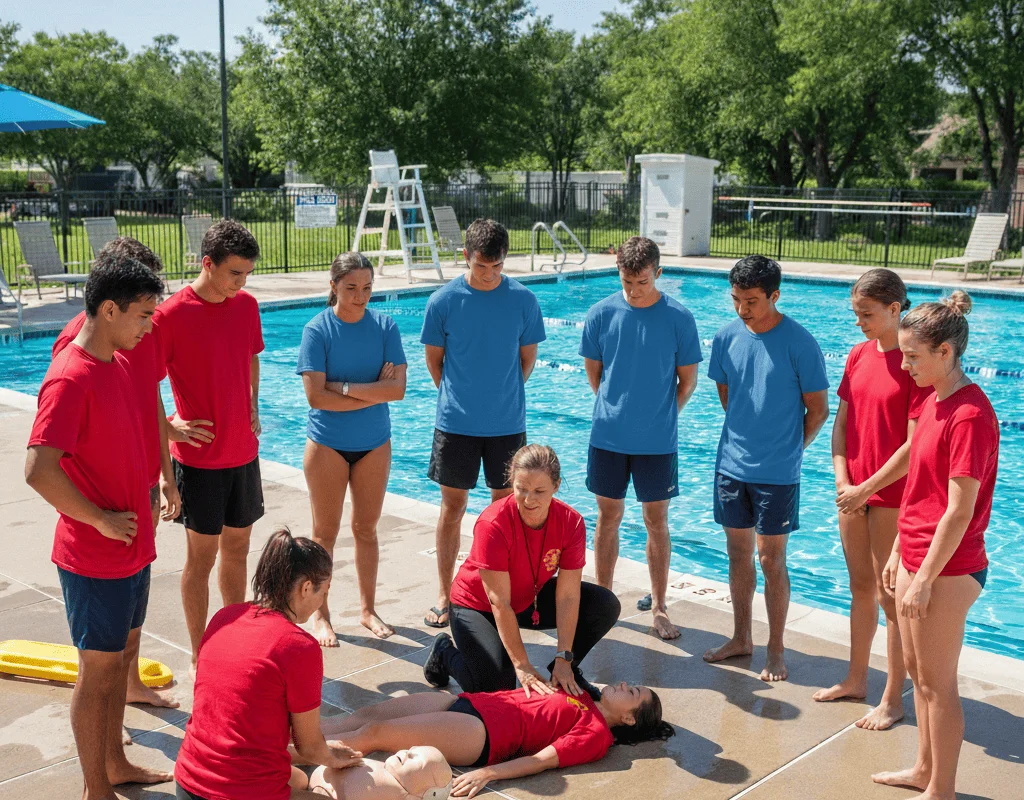
Proper hybrid training vs industry minimums
| Training Element | Proper Hybrid Training | Industry Minimum |
|---|---|---|
| Rescue evaluation | Multiple scenario assessments | Single demonstration |
| Vigilance testing | Zone scanning under fatigue | Verbal explanation |
| Emergency coordination | Team-based simulations | Individual response |
| Skills documentation | Observed and recorded | Often unverified |
| Employer acceptance | High | Variable |
A Lifeguard renewal class that meets only minimums may issue paperwork, but it does not always meet employer approval thresholds.
Step-by-Step Renewal Checklist
- Confirm certification status and expiration date
- Verify employer acceptance requirements
- Select a program with scheduled in-person sessions
- Prepare for swim endurance and submersion drills
- Complete live rescue and CPR evaluations
- Retain documentation for employer records
This checklist reflects what facilities expect when reviewing a Lifeguard renewal class submission for staffing approval.
Employer Acceptance Requirements Explained
From an employer review standpoint, acceptance depends on whether training aligns with workplace preparedness expectations. Facilities assess whether candidates completed real rescues, demonstrated vigilance, and participated in coordinated emergency response scenarios.
You should review In Person Lifeguard Training Standards and explicitly instruct that as it outlines how employers evaluate renewal credentials.
Recertification vs Renewal Clarified
Recertification often applies when credentials have expired beyond an allowable window. Renewal applies when certification remains current or recently lapsed. A Lifeguard renewal class focuses on validation rather than retraining from the ground up.
Frequently Asked Questions
What is a Lifeguard renewal class?
A Lifeguard renewal class is a short-term recertification program designed to verify active rescue skills, scanning techniques, and emergency response coordination through in-person evaluation rather than initial instruction.
Can a Lifeguard renewal class be completed online?
A Lifeguard renewal class cannot be completed fully online. Most employers reject online-only options because live rescue performance, vigilance, and coordination cannot be accurately assessed without in-person skills verification.
How long does a Lifeguard renewal class take?
Most renewal programs are completed in one to two days depending on evaluation depth, facility standards, and whether additional remediation is required during skills verification.
What happens if my certification is expired?
If certification is recently expired, many employers still allow renewal. Longer lapses often require full recertification rather than renewal to reestablish competency.
Do employers verify renewal documentation?
Yes. Employers routinely review documentation to confirm in-person training, rescue evaluations, and compliance with workplace preparedness expectations before approving staff.
Is CPR included in renewal training?
CPR skills are commonly reassessed during renewal, especially within integrated emergency response scenarios that mirror real aquatic incidents.
Should I confirm acceptance before enrolling?
Always confirm acceptance with your employer. Facilities apply different standards, and approval depends on how closely training aligns with their safety policies.
Conclusion
A Lifeguard renewal class exists to protect swimmers, employers, and guards themselves by ensuring real-world readiness. Choosing proper in-person training supports employer trust, regulatory alignment, and safer aquatic environments. A Lifeguard renewal class completed correctly keeps you eligible, confident, and prepared.
For the full guide, see lifeguard recertification.
Reviewed by Jackie Stern, Lifeguard Instructor, Firefighter and EMT. Jackie Stern has taught lifeguarding for more than 20 years and works as a firefighter, EMT and swim instructor. She reviews course content, prerequisites and rescue standards against current certification requirements.
About Us
We are a nonprofit that trains and certifies in Lifeguarding, Waterfront Lifeguarding, Junior Lifeguarding, Shallow Pool Lifeguarding, Sexual Harassment Training, CPR/AED, CPR for Lifeguards, First Aid Emergency Oxygen, and swimming lessons.
© Copyright American Aquatics and Safety Training. All Rights Reserved