CPR and First Aid Class

Last updated

Upcoming CPR and First Aid classes in New York

109 sessions are scheduled between Sun, Dec 6 and Sat, Jun 5 at Roslyn (Nassau County), Brooklyn (Kings County) and Stony Brook (Suffolk County). The table shows the next session of each course at each location; Book opens that course's booking page with every date. Prices are the booking prices.

CourseNext sessionLocationPriceBooking
CPR/AEDSun, Dec 6, 2:00 pm to 6:00 pmRoslyn (Nassau County)$125Book
CPR/AEDSun, Jan 24, 4:00 pm to 8:00 pmBrooklyn (Kings County)$125Book
CPR/AEDSat, Mar 13, 10:00 am to 2:00 pmStony Brook (Suffolk County)$125Book
First AidSun, Dec 6, 2:00 pm to 4:00 pmRoslyn (Nassau County)$80Book
Basic Life SupportSun, Dec 6, 2:00 pm to 6:00 pmRoslyn (Nassau County)$125Book
Basic Life SupportSun, Jan 24, 4:00 pm to 8:00 pmBrooklyn (Kings County)$125Book
Basic Life SupportSat, Mar 13, 10:00 am to 2:00 pmStony Brook (Suffolk County)$125Book
CPR for the Professional RescuerSun, Dec 6, 2:00 pm to 6:00 pmRoslyn (Nassau County)$125Book
CPR for the Professional RescuerSun, Jan 24, 4:00 pm to 8:00 pmBrooklyn (Kings County)$125Book
CPR for the Professional RescuerSat, Mar 13, 10:00 am to 2:00 pmStony Brook (Suffolk County)$125Book
Wilderness First AidSun, Dec 6, 2:00 pm to 6:00 pmRoslyn (Nassau County)$300Book

Training a team, school or workplace, in New York or elsewhere? See group CPR and first aid classes.

A combined CPR and first aid class covers chest compressions, rescue breathing, AED use, choking response and wound care, and issues certification on completion. Most courses run a few hours in a single session.
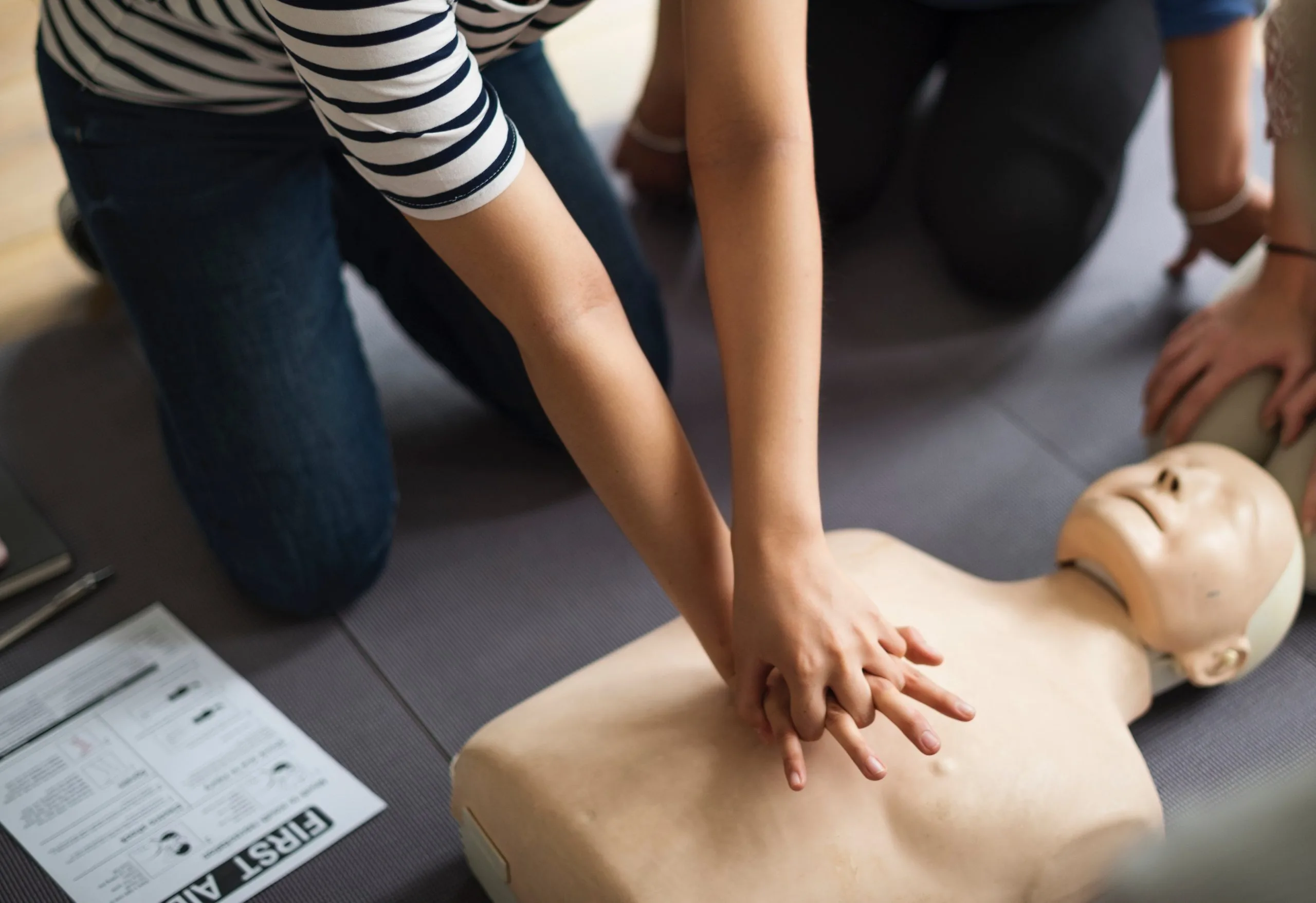
CPR and First Aid Class

Our CPR and First Aid class trains you to recognize a life-threatening emergency and act on it, from checking breathing and pulse through to rescue breathing, CPR and the use of an AED, alongside the first aid skills needed for injuries and sudden illness.

The class certifies you in two areas at once. Pass it and you receive certifications reading “CPR/AED for Professional Rescuers: Adult, Child, Infant & Pediatric” and “First Aid, Adult, Child, Infant, Pediatric”, each valid for two years from the date you complete the course.

We teach it across the United States, and you can take it fully in person or as blended learning. Every certificate carries its own certificate ID and QR code, so an employer can confirm it is genuine in seconds.

CPR and First Aid Class

What does the CPR and first aid class cover?

The class is taught from our own CPR/AED and First Aid course manuals. The CPR/AED half covers:

  • The responsibilities of the professional rescuer and how the EMS system works
  • Legal ground rules, consent, implied consent, duty to act, Good Samaritan laws, standard of care, negligence, abandonment and refusal of care
  • Preventing disease transmission: hand washing, gloves, barrier resuscitation masks, eyewear, and cleaning equipment after use
  • Assessing the scene and the victim, moving a victim, the recovery position and the H.A.I.N.E.S. position
  • Rescue breathing for adults, children and infants, using a resuscitation mask and a bag valve mask (BVM)
  • Special situations, air in the stomach, vomiting, drowning, dentures, and injury to the head, neck, chest or back
  • Conscious and unconscious choking in adults, children and infants
  • The cardiac chain of survival for adults, and for infants and pediatric patients
  • Signs and symptoms of a heart attack, including how they differ between men and women
  • One-rescuer and two-rescuer CPR for adults, children and infants, and when to start and stop CPR
  • Using an AED on an adult, a child and an infant, the rules for AED use, and how a unit is maintained

The First Aid half covers:

  • Recognizing life-threatening emergencies, no pulse, not breathing, major bleeding, head, neck or back injury, and drowning
  • Injuries that are not life threatening, scrapes, abrasions, avulsions, bruises, superficial burns, sprains, fractures and dislocations
  • Sudden illness, seizures, stroke, allergic reactions, poisoning, heat stroke, changes in level of consciousness, and changes in skin color, temperature and condition
  • What belongs in a first aid station, from bandages, splints and tourniquets to eye wash, burn dressings and non-latex gloves
  • The devices a well-equipped station carries: an epinephrine auto-injector, resuscitation mask, BVM and AED

The class follows AHA ECC guidelines, and the first aid course meets and exceeds OSHA guidelines.

Course length, format and how you pass

You can take the class fully in person, or as blended learning where the coursework is completed online at your own pace before an in-person skills session.

Taken fully in person, the combined class runs 8 hours 35 minutes: 4 hours 35 minutes for the CPR/AED course and 4 hours for the First Aid course. Taken as blended learning, the in-person time drops to 4 hours 50 minutes, being 2 hours 50 minutes and 2 hours respectively, because the coursework is completed online before the skills session.

To certify you must attend and take part in all class sessions, demonstrate every required skill, and pass the written exam with a minimum grade of 80 percent. The skills exam takes about ten minutes and the written exam about twenty. If you do not pass first time, you are given the chance to retake it using an alternative exam.

Skills are graded pass or fail. In a multiple-rescuer scenario the instructor grades the team on how well it works together as well as each student individually, so it is possible for the team to pass while one student is asked to repeat a skill.

Who the class is for

You never know when you will need these skills. Employers in caregiving, childcare, education, fitness, hospitality and customer-facing roles increasingly ask for them, and aquatic staff need them as a condition of working on deck. We do not just need doctors and paramedics, we need everyday members of the community trained in CPR and First Aid, so that first responders arrive to a patient who has already been kept stable.

The class is open to anyone who can meet the course objectives. We work with students who need accommodations under the Americans with Disabilities Act: a skill can be adapted as long as its objective is still met, and the written exam can be read aloud for a student with a learning disability or limited English proficiency.

Ready to book? Find a class near you, or contact us to arrange a session for your team.

Life-Saving Statistics
p.dash { margin-bottom: 14px; } ul.breadcrumb { display: none; } p.bt { margin-bottom: 2px; } p.textrk { margin-bottom: 14px; } ul.orderest { padding-left: 40px; }
jQuery(".logogroup img").prop("alt", "Taking a CPR and First Aid Class" ); jQuery(".logogroup img").prop("title", "Taking a CPR and First Aid Class" ); jQuery(".logogroup1 img").prop("alt", "CPR and First Aid Classes and What do CPR and First Aid classes cover?" ); jQuery(".logogroup1 img").prop("title", "CPR and First Aid Classes and What do CPR and First Aid classes cover?" );

Reviewed by Jackie Stern, Lifeguard Instructor, Firefighter and EMT. Jackie Stern has taught lifeguarding for more than 20 years and works as a firefighter, EMT and swim instructor. She reviews course content, prerequisites and rescue standards against current certification requirements.

American Aquatics and Safety Training, Inc. is a 501(c)(3) nonprofit organization. Tax ID (EIN) 83-4426661.

70 E. Sunrise Highway, Suite 500, Valley Stream, NY 11581

About our organization

This site is protected by reCAPTCHA and the Google Privacy Policy and Terms of Service apply.