Mon - Sat: 8:30-18:00

Last updated
Certification awarded: CPR/AED: Adult, Child, Infant, Pediatric. This is the exact title printed on your certificate, and it is the same in every state.
Getting ready for BLS? Try the free BLS practice test: 25 questions, every answer explained.
CPR/AED for BLS providers is for people who already work at basic life support level, or who are required to hold a BLS-level credential, and need current CPR and AED certification to keep working. It assumes you are not new to resuscitation: the course moves quickly through the background and spends its time on the sequences that are hardest to keep sharp between certification cycles.
Typical candidates are EMTs and emergency medical responders, nursing and allied health staff, medical and nursing students, physical and occupational therapists, dental teams, and anyone whose role description names BLS explicitly.
Who this version is aimed at
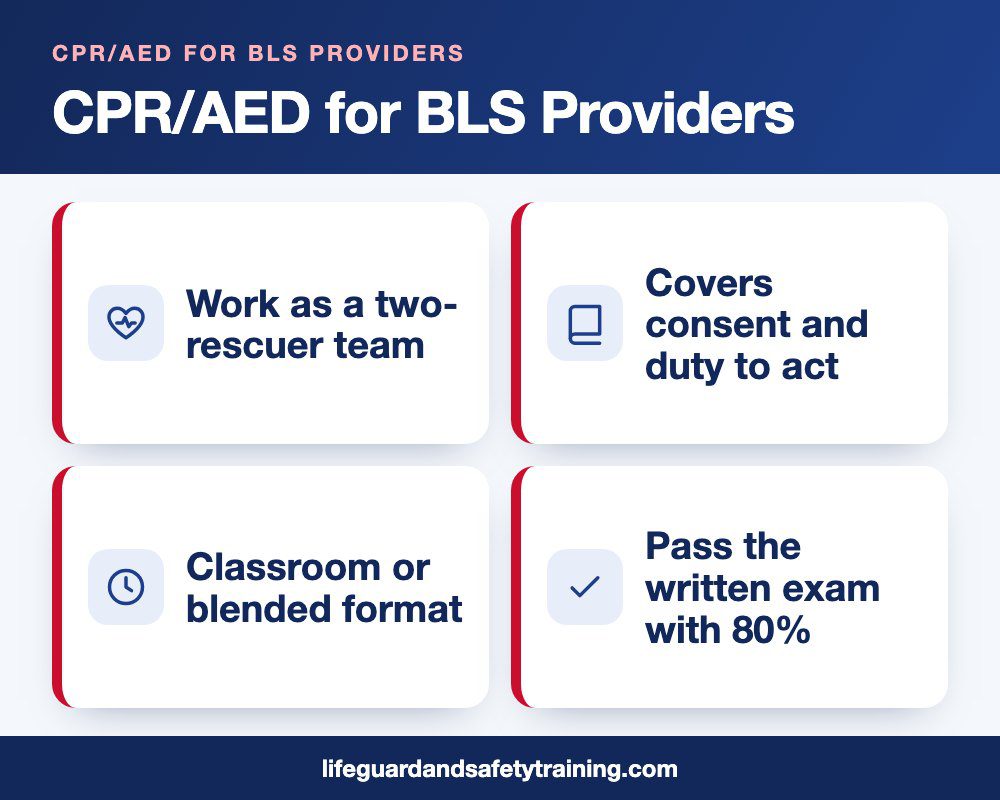
The distinction between this and our general CPR class is one of pace and emphasis, not of standard. A BLS provider is expected to arrive able to recognize cardiac arrest quickly, to deliver high-quality compressions without prompting, and to work as one half of a two-rescuer team. The course therefore front-loads assessment and recognition and gives the majority of its practical time to two-rescuer CPR, bag-valve-mask ventilation and defibrillation.
If you are certifying for the first time and have no clinical background, our general CPR class is the better starting point. If your work is aquatic rescue rather than clinical care, see CPR/AED for professional rescuers.
Course content
- Rescuer responsibilities and the emergency medical services system
- Legal issues: consent, implied consent, duty to act, standard of care, negligence, abandonment, refusal of care, recording and reporting an incident, right to privacy
- Preventing disease transmission: hand washing, gloves, barrier resuscitation mask, eye and foot protection, cleaning and disposing of equipment
- Initial assessment, scene assessment, and monitoring airway, breathing and circulation
- Breathing emergencies, rescue breathing, resuscitation mask technique including mask-to-nose and mask-to-stoma
- Conscious and unconscious choking relief for adults, children and infants
- Recognizing a heart attack, including how signs differ between men and women; the cardiac chain of survival for adults and separately for infants and children
- One-rescuer and two-rescuer CPR for adults, children and infants; when to start and when to stop
- AED use on an adult and on a child or infant, the rules of an AED, and AED maintenance
- CPR with a bag-valve-mask, and CPR/AED with a bag-valve-mask
How long does this CPR course take, and what formats are offered?
The course is offered in a classroom format and a blended format. Both end in the same examinations and produce the same certificate.
- In person: 4 hours 35 minutes (275 minutes) from start to finish, including a 10-minute skills examination and a 20-minute written examination.
- Blended: the knowledge portion is completed online in your own time, followed by 2 hours 50 minutes (170 minutes) of in-person instruction, skills practice, skills evaluation and the written examination.
The skills evaluation is always conducted in person, face to face with an instructor, on manikins and real equipment. It is never done by webcam or on a virtual manikin, and no certificate is issued on the online coursework alone. That is worth checking against any provider offering a “fully online” card. Classes are capped at ten participants per instructor so that everyone gets hands-on time; above that number a second instructor or an authorized assistant is added.
What is the passing standard for certification?
There is one standard, and it applies whether this is your first certification or your fifth. To certify you must attend and take part in every session, demonstrate every required skill to the instructor, and pass the written examination with a minimum score of 80 percent. If the written examination is not passed the first time, you are given the opportunity to retake it using an alternative version at no extra cost.
Your certificate names you, the course, the issue date, the expiry date, the certifying instructor and American Aquatics and Safety Training as the issuing organization. It carries an ID and a QR code so an employer can verify it online. Certification is valid for two years.
Renewal is the same course, delivered in full. Someone renewing an expiring certificate sits the same instruction, passes the same written examination at the same 80 percent standard, and completes the same skills evaluation as a first-time candidate. AAST does not run a shortened refresher, so there is no difference in content, length or standard between an initial certification and a renewal.
How do state requirements affect the wording on my certificate?
BLS-level roles are often tied to a state license, so it is worth knowing exactly which part of your certificate can vary by state. The course itself is built and taught from the American Aquatics and Safety Training CPR manual, and that curriculum does not change from one state to the next: the skills, the sequence, the instructional time and the passing standard are the same everywhere.
What can change is the wording printed on the certificate. The course title on every certificate AAST issues is CPR/AED: Adult, Child, Infant, Pediatric, and that title is fixed in every state. Where a state or its Department of Health requires additional wording (an approval or provider number, or a line confirming the course meets that state’s requirement), it is added on a separate line beneath the course title. The course title itself is never altered, so a certificate remains recognisable wherever it is presented.
If you are training to satisfy a specific state license, board or Department of Health rule, tell us which one when you book. We will confirm the wording that will appear on your certificate before the class runs, and add the line that state requires. Employers can check any certificate we issue through our certification verification page.
Who issues this certification?
American Aquatics and Safety Training is a not-for-profit certifying body based in New York. We write the curriculum, train and authorize the instructors, and issue the certification ourselves. Course content follows the current ILCOR consensus on science and the American Heart Association guidelines for CPR and emergency cardiovascular care. AAST is not affiliated with, and does not certify on behalf of, the American Heart Association or the American Red Cross.
Frequently asked questions
Does this replace an AHA BLS Provider card?
Only if your employer accepts certification from AAST. We are an independent not-for-profit certifying body following ILCOR consensus and AHA guidelines, but we are not an AHA training center and do not issue AHA cards. Where an employer specifies the issuing organization by name, check with them first.
I am renewing. Is there a shorter course?
No. Renewal is the same course in full, at the same 80 percent written standard and the same skills evaluation.
How many people can be in a CPR/AED for BLS Providers class?
Ten per instructor. Above that a second instructor or an authorized assistant is added, so the hands-on time per person does not fall.
Book this course
Keep your BLS-level certification current without losing a day to it. Open classes are published on our CPR/AED class schedule, and we also run this course on site at your own facility on request. For group bookings and on-site scheduling, contact our team.
Reviewed by Jackie Stern, Lifeguard Instructor, Firefighter and EMT. Jackie Stern has taught lifeguarding for more than 20 years and works as a firefighter, EMT and swim instructor. She reviews course content, prerequisites and rescue standards against current certification requirements.